
legacy, left on read
a family’s silence, a nation’s silence, and one metal song that split it open

i braced myself as i pressed send on a handful of messages to the extended family whatsapp group chat, a place where marriages and medical degrees get top billing. generally speaking, no one expects to hear from the childless, divorced, eldest female niece and resident black sheep of the family.
they certainly don’t expect a clip of her roaring into a mic at a metal show wearing a white sari and doc martens.
and, least of all, they do not want to hear that the lyrics she’s spitting give a voice to the voiceless that no one dares to name: the victims of sexual violence from the bangladeshi liberation war of 1971.
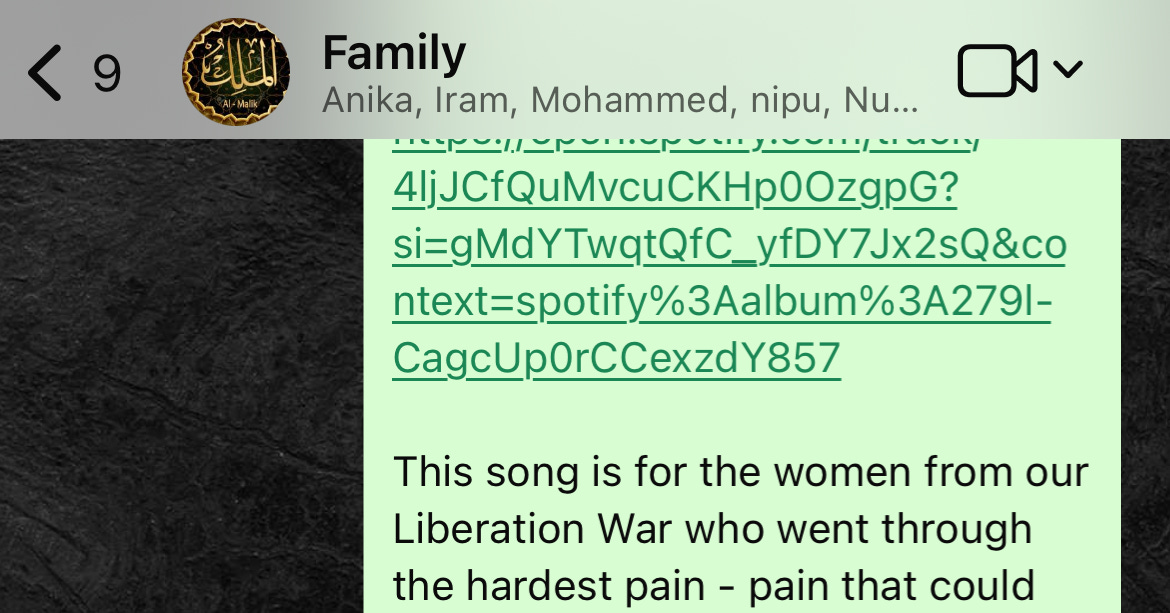
to add insult - this is a chat that floods with hundreds of updates about the seasonal mango harvest from everyone’s backyard gardens - and the song she’s screaming was written and recorded by her only brother. also known as tahmid, the now-deceased nephew and cousin everyone prefers to avoid mentioning, lest he raise discomfort and guilt about how little effort they made to know the man who lived a short but nothing short of miraculous life.
bangladesh became an independent, sovereign nation in 1971, in the wake of a brutal nine-month war. not all battles were fought through bloodshed or on a battlefield. during the war, the pakistani army, razakar paramilitaries, and their local collaborators raped ~400,000 bengali women (conservatively estimated).
the atrocities committed were the first recorded example of rape used as a weapon of war in modern memory. but history itself gets written by men, and often for men - so the liberation war’s dominant myth is about armed struggle and heroic resistance.
and when patriarchal, conservative societies tie a woman’s value to sexual purity, mass rape of women is inconvenient. so inconvenient, in fact, it doesn’t even make it into school books. to say there’s generational trauma around the atrocities committed by the pakistani army upon the women of bangladesh is an understatement.
growing up, i made a four-hour daily round trip to an all-girls academically selective high school. asian immigrant parents prioritising academic success is unsurprising, but i’d also been accepted to a co-ed selective school much closer to home.
the commute was justified when it was tied to a fact i’d absorbed as gospel at a very young age. by the age of 11, through murmurs and coded whispers, i’d understood that there exists a fate worse than death: rape.
metal can be entertaining, but it’s not entertainment. in Hail Mary’s first release, MOTHERLY MARTYRDOM, tahmid vivdly describes, in graphic detail, his fury for the horrors that our elders didn’t dare to name.
but choosing not to name the violence doesn’t make it go away. instead it bleeds into the way we raise our daughters. the fears we instill without ever explaining why.
but tahmid understood. not because he was taught, but because he was tahmid: a lifelong systems thinker who researched, observed, investigated, and connected the dots.
growing up, i was irritated by the way tahmid adopted every single interest i had. if i started listening to a band, he’d be wearing their t-shirt a week later. i turned thirteen, started swapping msn messenger details with boys at skate parks, and saved up pocket money for an og pair of macbeths from the PSC store at westpoint (checking to see if they were still in stock each week). within a month, tahmid decided he was a skater and i never saw those shoes again. lather, rinse, repeat.

(seriously, look at the coolest man you think you know. now look again. i can almost guarantee he’s just a by-product of a tomboy older sister.)
a few - well, a lot - of years later, i finally realised that he wasn’t copying me so much as he was worshipping me, which could only be reframed as the most endearing and loving shit ever.
as we got older, tahmid picked up on confusing clues: i had a two-hour commute to an all-girls school while he went to a co-ed school fifteen minutes away. my parents would call the cops if i wasn’t on the first train home they’d marked on the timetable, while tahmid could spend non-dialysis afternoons doing whatever he wanted. he was the only one of us allowed to wear spray-on jeans, while i had to carefully plan a routine to hike up my school skirt as soon as i left the bus stop, so it didn’t trail beneath my knees.
i never realised how closely he’d paid attention to all the parental screaming matches he overheard and my tears he’d wiped, until my 2016 wedding. tahmid gave a speech, kinda. it was more that he silenced over 700 guests in a glittering ballroom to unleash sheer fury on the bengali community.
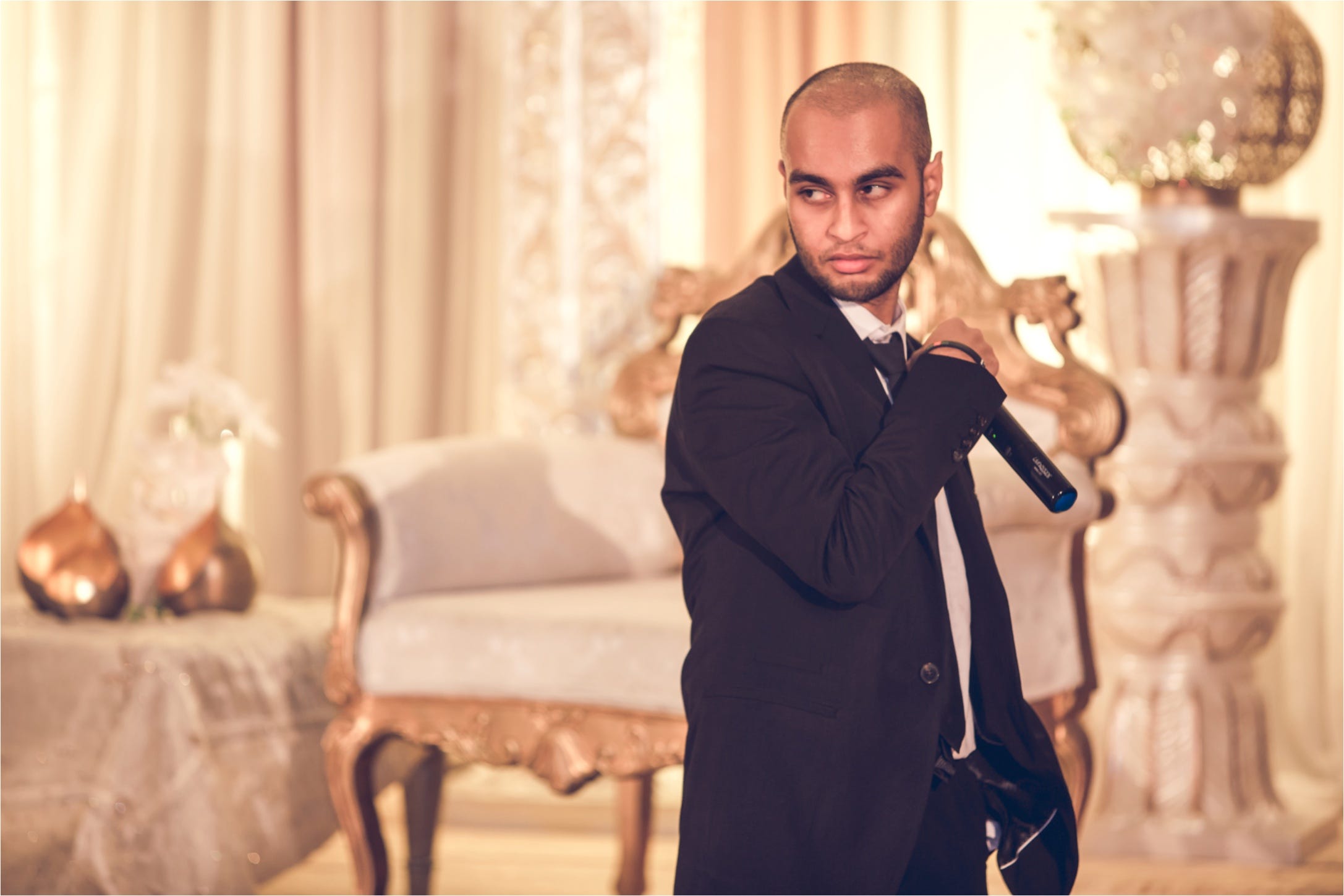
he declared that the generational trauma we refused to acknowledge instead formed a double-standard of how we raised our daughters compared to our sons. tahmid cursed every person who upheld the vicious cycle of impossible expectations placed upon the women of the bengali community.
tahmid raged with vengeance for over twenty minutes. devastatingly, there isn’t a recording of his speech. but any lucky witnesses will tell you this was the gist of it:
“i single-handedly became the man i am today because i watched the way you condemned my sister for simply becoming the woman she wanted to be. shame on you for enabling your own wounds to inflict irreparable damage upon the person i love the most. every one of you is complicit. and every one of our mothers, daughters, and sisters deserve better than this.”
he stood in that ballroom and made every uncle seethe and every woman cry, and i think it will always be the greatest act of love i’ll ever know.
the HAIL MARY EP is extraordinary. a team of legends worked tirelessly to bring the record to life, to honour tahmid and his legacy. if tahmid were here, i truly believe MOTHERLY MARTYRDOM could have achieved something remarkable: bringing awareness to the horrors endured by bengali women, a way to address the damaging impact of silence.
but tahmid isn’t here. and despite grief and loss colouring our landscape in the process, i like to hope he believes we’ve tried our damn best.
i hope so, because i know that:
the language of bangla, and my right to speak it, was borne of protest
the bengali national anthem, amar sonar bangla, is a song of maternal imagery. it is an ode to mother bengal, a personification of a beloved mother, whose suffering and joy are shared by her children
tahmid wrote MOTHERLY MARTYRDOM as his ode to mothers, daughters, and sisters, and how there is no limit to the debt we owe for their sacrifice.
my messages in the family whatsapp group are still unacknowledged. no emojis, no mashallahs, not even a pity thumbs-up. it’s a familiar silence: silence is my family’s most fluent language, as it is for many bengali families in bangladesh and across the globe. over half a century of silence, but the impact still deafens.
tahmid took that silence and churned it into roars. and in his absence, i had the privilege of roaring for him as his proxy. i don’t need a pity thumbs-up reaction. not when i know in my bones i was loved, in the most unconditional way possible, by the greatest man i will ever know.
tahmid was a revolutionary, and his magnum opus gave silence a sound.
MOTHERLY MARTYRDOM
Lyrics by: Tahmid Nurullah, 2024
VERSE 1
A Language,
One held with Pride
One we would defend
If the cost meant
That We would Die
CHORUS
At what value is identity?
When it comes at the cost of dignity
A pillaged country,
An abused Mother
Shame to her fertility
VERSE 2
The price I paid
For keeping
my mother’s tongue
Were the scars
Of mother’s sacrifice
To this day, go unsung
Matriarch,
Of this identity,
She bears the scars of violence
She wears it outside
And worse internally
To this day, her womb still bleeds
CHORUS
At what value is identity?
When it comes at the cost of dignity
A pillaged country,
An abused Mother
Shame to her fertility
VERSE 3
The birth of a nation,
Of Our liberation
Came Through her molestation
Our emancipation
Her degradation
BRIDGE
Violation
of a nation
Horror, Birthed through despair
Violation
Of A nation
Horror
lives through the womb.
VERSE 4
On my deathbed
The reaper, she visits me
Cloaked in a blood-stained Sari
To remind me
The guilt of this identity
Beautiful writing, girl ❤️❤️
This is the one.